






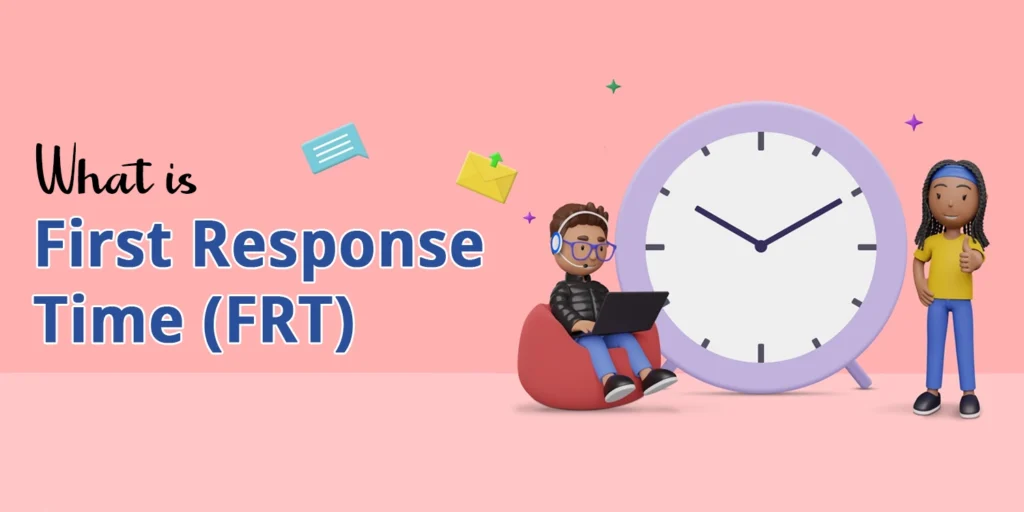

First Response Time or FRT refers to the time that an organization takes to respond back for the first time after receiving an inquiry from its customers. FRT is measured across various communication channels such as e-mail, chat, tickets, messages, and more.
Having a low FRT helps to eliminate any form of ambiguity and assures the customer that his/her query has been received. Nonetheless, there has to be a valuable response as an immediate acknowledgment doesn’t count as a valuable response at all.
What Is First Response Time?
First Response Time is the period between the moment a customer submits an enquiry and the moment a support representative provides the first meaningful reply.
For example, if a customer sends an email at 10:00 a.m. and an agent responds at 10:25 a.m., the FRT is 25 minutes.
The metric focuses only on the first response. It does not measure how long the complete issue takes to resolve.
This distinction is important:
- First Response Time measures initial responsiveness.
- Average Resolution Time measures how long it takes to close the issue.
- First Contact Resolution measures whether the issue is resolved during the first interaction.
A fast first response can reassure the customer, but it should be reviewed alongside resolution and quality measurements.
How Is First Response Time Calculated?
The average First Response Time formula is:
Average FRT = Total time taken to send first responses ÷ Number of customer enquiries
Suppose five customer enquiries receive first responses after 10, 15, 20, 25 and 30 minutes.
The combined response time is 100 minutes.
Average FRT = 100 ÷ 5 = 20 minutes
Only eligible enquiries should be included. Businesses may exclude spam, duplicate tickets, test messages and requests received outside contracted support hours, depending on their reporting policy.
The calculation should use the same rules every reporting period. Otherwise, teams may appear to improve simply because the measurement method changed.
Why Does First Response Time Matter?
When customers make a request and don’t get any feedback on whether it is being processed, they feel doubtful about the procedure. It is important to inform customers that you got their request and explain what will be done further.
Effective FRT management can support:
- Lower customer waiting time
- Better queue visibility
- Fewer duplicate messages
- More consistent service levels
- Earlier identification of urgent issues
- Improved workload planning
- Greater customer confidence
Slow responses can cause customers to submit the same enquiry through several channels. A person may send an email, start a live chat and then call because the original request was not acknowledged.
This leads to unnecessary duplication of work and will make the support process seem more active than it is.
Structured customer support services can assist businesses in arranging the support process, such as phone, email, chat, complaints, and follow-ups.
What Constitutes a Meaningful First Response?
A meaningful first response would mean that the customer’s query has been read and there is now some action taken accordingly.
A useful response may:
- Answer the customer’s question
- Ask for specific missing information
- Confirm that a case has been created
- Explain which team is reviewing the request
- Provide a realistic update timeframe
- Share relevant troubleshooting instructions
- Confirm that an urgent matter has been prioritised
A generic automated message such as “We received your enquiry” may be useful as an acknowledgement, but it should not always be counted as the first meaningful response.
For example:
Weak response:
“Thank you for contacting us. We will reply soon.”
Meaningful response:
“Thank you for reporting the login problem. We have created ticket 4582 and assigned it to our technical team. Please confirm the email address connected to your account so we can review the issue.”
The second response gives the customer useful information and moves the case forward.
What Is a Good First Response Time?
There is no universal FRT target for every business or support channel. A suitable target depends on customer expectations, issue urgency, operating hours, staffing levels and contractual service standards.
| Support Channel | General Expectation |
|---|---|
| Live chat | Near-immediate response |
| Phone | Answered while the customer remains in the queue |
| Social messaging | Usually faster than email |
| May range from minutes to several business hours | |
| Support tickets | Based on priority and agreed service levels |
Live channels naturally require faster responses than asynchronous channels. Customers using chat usually expect an agent to respond quickly, while email allows more time for research and a detailed answer.
Dazonn Assist describes chat support services as real-time assistance supported by agent assignment, query identification, ticket creation, and escalation workflows.
Businesses should set different targets for each channel instead of applying one average to every interaction.
What Causes a High First Response Time?
Slow first responses are not always caused by agents working too slowly. Delays can result from wider operational problems.
Common causes include:
- Insufficient staffing during peak hours
- Inaccurate contact-volume forecasts
- Poor ticket routing
- Unclear enquiry categories
- Too many disconnected support channels
- Manual assignment of every request
- Limited knowledge-base access
- Slow customer service software
- Unclear service-level priorities
- Large backlogs from previous shifts
- Agents completing too much administrative work
- Lack of after-hours coverage
A high FRT may also indicate that complex and simple enquiries are entering the same queue. A basic order-status question should not necessarily wait behind a case requiring detailed technical investigation.
Businesses using inbound call center services can structure incoming requests through routing, ticket creation, prioritisation, resolution and follow-up stages.
How Can Businesses Improve First Response Time?
Improving FRT requires changes to staffing, workflows, technology and performance management.
Set channel-specific service levels
Define realistic first-response targets for phone, chat, email and support tickets. Targets should also reflect operating hours and issue priority.
An urgent account-security enquiry may need a faster response than a general product question.
Improve routing and categorisation
Use forms, IVR options, ticket fields or chat prompts to identify why the customer is contacting the business. Requests can then be routed to agents with the appropriate knowledge.
Match staffing to demand
Review contact patterns by hour, day and channel. Schedule more agents when demand regularly increases, and prepare contingency plans for product launches, service disruptions or seasonal peaks.
Use automated acknowledgements carefully
Automation can confirm receipt, provide a ticket number and share expected response times. It should not be used to make performance reports appear faster when no employee has reviewed the enquiry.
Create response templates
Approved templates can help agents answer common questions consistently. Templates should be editable so the response reflects the customer’s actual situation.
Maintain an accurate knowledge base
Agents respond faster when policies, product details and troubleshooting instructions are easy to find. Outdated or poorly organised knowledge articles increase delays and errors.
Prioritise urgent requests
Security concerns, service outages and time-sensitive account problems may require priority routing. Clear rules help agents identify urgency consistently.
How Can Technology Reduce Response Delays?
Customer support platforms can automatically organise incoming requests according to channel, priority, topic, customer type or required agent skill.
Useful technologies include:
- CRM platforms
- Helpdesk and ticketing systems
- Automatic call distribution
- Live chat software
- Chatbots for basic requests
- Knowledge management systems
- Workforce management tools
- Queue and SLA alerts
- Reporting dashboards
Technology is most useful when systems are connected. Agents should be able to review relevant customer history without searching several separate platforms.
Businesses offering detailed written assistance may also use email support services for enquiries that require documentation, investigation or structured follow-up.
Automation should support agents rather than prevent customers from reaching human help. Complex, sensitive or unusual requests still require judgement and clear communication.
Which Metrics Should Be Tracked with FRT?
First Response Time does not show whether the customer received a correct answer or whether the issue was eventually resolved.
It should be reviewed with:
- First Contact Resolution
- Average Resolution Time
- Customer Satisfaction
- Customer Effort Score
- Ticket Reopen Rate
- Abandonment Rate
- Backlog Volume
- Transfer Rate
- SLA Compliance
- Quality Assurance Score
A very low FRT combined with poor resolution may indicate that agents are sending quick but unhelpful replies.
Managers should also review FRT by channel, issue type, priority and time of day. One overall monthly average can hide serious delays affecting a specific queue.
Common First Response Time Mistakes
Businesses often focus on reducing the average without reviewing response quality.
Other common mistakes include:
- Counting automated acknowledgements as agent responses
- Using the same target for every channel
- Ignoring business hours when calculating FRT
- Setting targets without reviewing staffing capacity
- Rewarding speed while ignoring accuracy
- Measuring averages without checking extreme delays
- Failing to separate urgent and routine requests
- Changing targets without documenting the reason
Median and percentile measurements can provide additional context. Averages may look acceptable even when a smaller group of customers waits much longer than expected.
Build a Faster and More Reliable Response Process
First Response Time improves when incoming requests are visible, correctly prioritised and assigned to available agents with the right information.
Businesses should begin by defining what qualifies as a meaningful first response. They can then set channel-specific targets, review demand patterns, improve routing and remove unnecessary workflow delays.
The aim is not to send the fastest possible message. It is to acknowledge the customer promptly, provide useful information, and create a clear path towards resolution.