



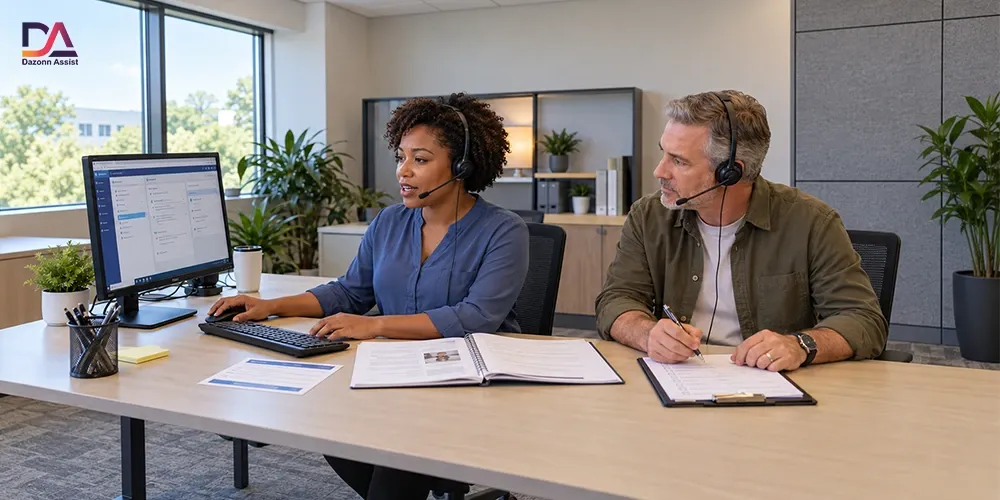

A call center agent may handle dozens of customer conversations during a shift. Some involve simple questions, while others require technical knowledge, patience, and quick decisions.
Without proper training, even experienced agents can struggle with difficult customers, unfamiliar systems, or changing company policies.
Effective call center training prepares agents to manage these situations confidently while maintaining service quality.
What Is Call Center Training and Why Is It Important?
Call center training is a structured process that develops the communication, product knowledge, technical, and problem-solving skills agents need to handle customer interactions. It includes initial onboarding, practical exercises, performance assessments, and ongoing coaching. Effective training helps agents resolve issues accurately, follow company procedures, and deliver consistent customer experiences across communication channels.
Training also supports business performance by improving:
- Customer satisfaction and service quality
- First-contact resolution
- Agent confidence and productivity
- Compliance with company policies
- Handling of complex customer complaints
However, training should focus on accurate resolutions rather than simply reducing call duration.
What Essential Skills Should Call Center Agents Learn?
A successful training program combines communication abilities with practical operational knowledge.
1. Communication and Active Listening
Agents should learn to understand customer concerns before suggesting solutions.
Training should cover clear explanations, professional language, appropriate tone, and asking relevant questions.
Role-playing exercises can help agents respond naturally instead of depending entirely on scripts.
2. Problem-Solving and Complaint Handling
Some customers contact support after experiencing repeated problems.
Agents need to identify the issue, explain available options, and know when escalation is necessary.
For example, customer support services often involve complaint handling, refunds, account questions, and follow-ups requiring different resolution procedures.
3. Product and Process Knowledge
Agents should understand the products or services they support, including common problems, account policies, and approved solutions.
In technical support services, this may include troubleshooting steps, ticket classification, and escalation procedures.
4. CRM and System Navigation
Training should include practical experience with customer relationship management (CRM) software, ticketing systems, call controls, and knowledge bases.
Agents must also understand how to document customer conversations accurately while protecting sensitive information.
How Should a Call Center Training Program Be Structured?
An effective training program moves from basic knowledge to supervised customer interactions.
Stage 1: Initial Onboarding
Introduce agents to company policies, products, customer expectations, and communication standards.
Explain their responsibilities, working procedures, and available support resources.
Stage 2: Practical Skills Training
Use demonstrations, mock calls, and realistic customer scenarios.
Exercises should cover common inquiries, frustrated customers, technical problems, and situations requiring supervisor assistance.
Stage 3: Supervised Customer Interactions
Allow agents to handle appropriate real interactions while experienced supervisors provide guidance.
Evaluate accuracy, communication, documentation, and resolution quality before increasing responsibilities.
Stage 4: Continuous Learning
Training should continue after onboarding.
Use short refresher sessions when products, systems, or policies change. Update training materials based on recurring customer issues.
This approach helps ensure that agents develop practical skills rather than simply completing training modules.
How Can Coaching and Quality Assurance Improve Agent Performance?
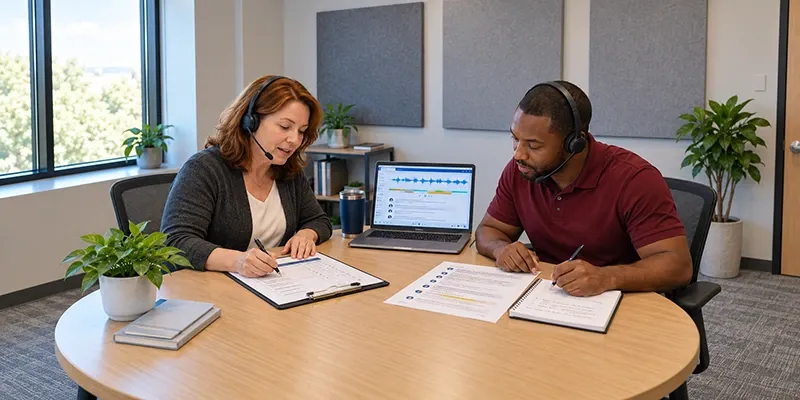
Call center coaching provides personalized feedback to help agents improve specific skills.
Quality assurance (QA) evaluates interactions against established service standards.
Both activities work best together.
An effective coaching process includes:
- Reviewing representative customer interactions.
- Identifying strengths and specific improvement areas.
- Discussing alternative responses or solutions.
- Practising the targeted skill through role-playing.
- Reviewing subsequent interactions to assess progress.
For example, an agent may provide accurate information but interrupt customers frequently. Coaching should focus on listening rather than recommending unrelated product training.
Supervisors should also apply consistent evaluation criteria.
Coaching should remain constructive and give agents opportunities to ask questions without fear of unfair criticism.
How Are AI and Technology Changing Call Center Training?
Modern call centers increasingly use digital tools to support training and performance monitoring.
AI-Assisted Coaching
AI-powered tools can analyze conversation transcripts, identify recurring issues, and highlight possible coaching opportunities.
Some systems also provide guidance during customer interactions.
However, supervisors should verify AI-generated assessments before making important decisions.
Learning Management Systems
A Learning Management System (LMS) helps organizations distribute training materials, track course completion, and manage assessments.
Agents can revisit instructions when procedures change.
Conversation Simulations
Interactive simulations allow trainees to practise complaint handling, troubleshooting, and customer communication without affecting real customers.
Omnichannel Training
Modern contact centers may handle phone calls alongside email, messaging, and live chat support.
Agents need channel-specific communication skills while maintaining consistent service information.
Microsoft’s Quality Assurance Agent documentation also emphasizes appropriate oversight and legal requirements when AI tools monitor customer interactions.
Businesses must consider privacy, recording permissions, and data security when adopting these technologies.
Which KPIs Measure Call Center Training Effectiveness?

Training effectiveness should be evaluated using customer outcomes, interaction quality, and operational performance.
| Metric | What It Measures |
|---|---|
| First-Contact Resolution (FCR) | Issues resolved during the initial interaction |
| Average Handle Time (AHT) | Average time required to handle an interaction |
| Customer Satisfaction Score (CSAT) | Customer satisfaction with support |
| Quality Assurance Score | Compliance with defined service standards |
| Repeat Contact Rate | Customers contacting support again about the same issue |
| Agent Training Completion | Progress through required training activities |
How Should Businesses Use These Metrics?
Start by recording performance before training begins.
After implementing coaching or new learning modules, compare results over a consistent period.
For example, if agents receive additional troubleshooting training, review whether first-contact resolution improves and repeat contacts decrease.
A lower average handling time is not automatically positive if more customers must call again.
Combine performance data with quality reviews, customer feedback, and agent assessments.
Also remember that product defects, understaffing, and system failures can affect performance independently of training.
Common Call Center Training Mistakes to Avoid
Even well-planned training programs can become ineffective when they focus on the wrong priorities.
Common mistakes include:
- Relying only on scripts: Agents need enough knowledge to respond appropriately to unusual situations.
- Ending training after onboarding: New products, policies, and customer expectations require regular updates.
- Using unrealistic exercises: Practice scenarios should reflect actual customer problems.
- Ignoring agent feedback: Employees often identify gaps in procedures and training materials.
- Prioritizing speed over quality: Short calls are not always successful calls.
Another mistake is using the same coaching plan for every employee.
New agents may need foundational knowledge, while experienced employees may benefit from specialized troubleshooting or leadership development.
Build a Training Program That Supports Better Customer Experiences
Improving call center performance requires more than teaching agents how to answer calls.
Businesses should combine structured onboarding, practical exercises, consistent coaching, and meaningful performance reviews.
Training must also evolve as customer expectations, communication channels, and technologies change.
Dazonn Assist provides call center outsourcing services for businesses requiring dedicated customer communication teams and structured operational support.
The goal of effective training remains simple: help agents solve customer problems accurately, confidently, and consistently.